
cv | works | sculptures | site specific | environmental | land art | architectural | publications | exhibitions | symposia/lectures | cities | encounters | accounts
LAND ART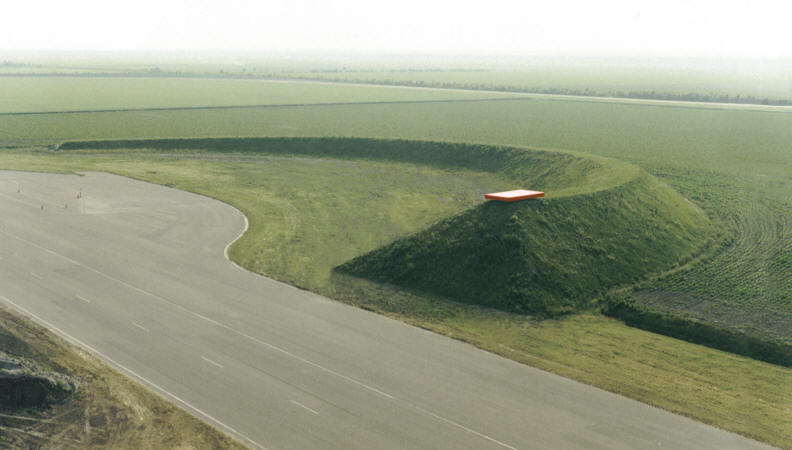
Land art with red steel element - land art project, homage to El Lissitzky - 1985|1986 - 100x200x7.50m, made with the earth from the original sea bottom - test circuit and test center of the national Road and Transport Department of The Netherlands - Lelystad NL (the work has been demolished in the early nineties). See the flyover aerial video I made in the mid-eighties below.
art in the land and land in art - projects by Lucien den Arend
LAND ART projects by the sculptor were influenced by the characteristics of the Dutch landscape. His earth art, earthworks or landart is a projection of this man-made land - a flat, and geometrically laid out landscape. The landscape in Holland is flat and the land has been completely designed by man. Whereas land art is usually made in natural surroundings, it is a difficult task for an artist to design in an already planned environment. An urban land art project is often the result.
The first land art which the sculptor executed was a design for an interior garden in the DSW factory in Dordrecht, Holland. It would be his first land art project in Holland. He started with his first proposal in 1969. The landscape of the location - before the factory was built - had evolved into agricultural area, consisting of fields with the River Dubbel meandering through them. He used this aspect of the former landscape by using the perimeter of the patio as a frame through which the observer could get a view of the former characteristics of the landscape on which the DSW plant had been projected.
Sometimes site specific sculpture and land art can be located in remote areas. One would argue that the public can't see the art, so what is the sense of it then? First of all there will always be interested people who go to see the work. Sometimes these works depend on their isolated environment. But let's not forget another argument: through photography and video it is now possible to make these works accessible for a much greater public than the numbers of people that actually visit these works of land art, site specific sculpture or whatever classification that art historians have contrived or will think of in the future.

trajectory for Rembrandt - 2002 - Salix Alba (white willow) - arc length 250m - Baarn NL (view to the south)
Read more about the sculptor's views on land art - an interview.
Land art uses land as a medium. The land is the material and the tools are those which have always been used to shape the land.
Is there a correlation between the awareness of the implications, which society's technical, as well as cultural, development has on the environment and the emergence of land art? Which one of these two preceded the other is probably of no importance. Land Art emerged during the same period. On one hand it was the perception of the artists who noticed the importance of our environment over profit which we can get from consuming it? But at the same time, I am certain, it was our possibility to move landscapes with machines which are as easy to manipulate as a hammer and chisel - or a paint brush for that matter.
Urban Land Art
Urban land art is not very different from land art as we know it. It uses the land as if there has never been any urban development. This is almost a form of historization - and sometimes it actually is.
from
Wikipedia, the free encyclopedia
"Land art or earth art
is a form of art which came to prominence in the late 1960s and 1970s primarily
concerned with the natural environment. Materials such as rocks, sticks,
soil, plants and so on are often used, and the works frequently exist in
the open and are left to change and erode under natural conditions. Particularly
large works are sometimes known as earthworks. Many of the works were ephemeral
in nature and now only exist as photographic documents. Already in the thirties
Isamu Noguchi was going beyond the traditional concept of sculpture. In
1941 he made a design for
Contoured Playground. His influence on contemporary land art and environmental
sculptures is evident in many works today.
Many of the works were ephemeral
in nature and now only exist as photographic documents.
The movement
was inspired mostly by modern and minimal movements such as De Stijl, Cubism,
Minimalism and the work of Constantin Brancusi and Joseph Beuys. Many of
the artist associated with 'Land art' had been involved with Minimalism
and Conceptual Art but according to the critic Barbara Rose writing in 'Artforum'
in 1969 had become disillusioned with the commodification and insularity
of gallery bound art. The sudden appearance of Land Art in 1968 can be located
as a response by a generation of artists mostly in their late twenties to
the heightened political activism of the year and the emerging environmental
and women's liberation movements.
The movement was 'launched'
in October 1968 by the group exhibition 'Earthworks' at the Dawn
Gallery in New York. In February, 1969, Willoughby Sharp curated the historic "Earth
Art" exhibition at the Andrew Dickson White Museum of Art at Cornell
University, Ithaca New York. Perhaps the best known artist who worked in
this genre was the American Robert Smithson whose 1968 essay "The Sedimentation
of the Mind: Earth Projects" provided a critical framework for the
movement as a reaction to the disengagement of Modernism from social issues
as represented by the critic Clement Greenberg. His best known piece, and
probably the most famous piece of all land art, is Spiral Jetty (1970),
for which Smithson arranged rock, earth and algae so as to form a long (1500
feet) spiral-shape jetty protruding into Great Salt Lake in Utah. How much
of the work, if any, is visible is dependent on the fluctuating water levels.
Since its creation, the work has been completely covered, and then uncovered
again, by water.
Smithson's Gravel Mirror with Cracks and Dust
(1968) is an example of land art existing in a gallery space rather than
in the natural environment. It consists of a pile of gravel by the side
of a partially mirrored gallery wall. In its simplicity of form and concentration
on the materials themselves, this and other pieces of land art have an affinity
with minimalism. There is also a relationship to Arte Povera in the use
of materials traditionally considered "unartistic" or "worthless".
Land artists have tended to be American, with other prominent artists
in this field including Nancy Holt, Walter De Maria, Hans Haacke, Alice
Aycock, Dennis Oppenheim, Michael Heizer, Alan Sonfist, and James Turrell.
Turrell began work in 1972 on possibly the largest piece of land art thus
far, reshaping the earth surrounding the extinct Roden Crater volcano in
Arizona. Perhaps the most prominent non-American land artists are the British
Richard Long and Andy Goldsworthy. Some projects by the artist Christo (who
is famous for wrapping monuments, buildings and landscapes in fabric) have
also been considered land art by some, though the artist himself considers
this incorrect, as explained on his web page. Joseph Beuys' concept
of 'social sculpture' influenced 'Land art and his 'Eichen'
project of 1972 to plant 1000 Oak trees has many similarities to 'Land
art processes.
Land artists in America relied mostly on wealthy patrons
and private foundations to fund their often costly projects. With the sudden
economic down turn of the mid 1970s funds from these sources largely dried
up. With the death of Smithson in a plane crash in 1973 the movement lost
its figurehead and petered out. Turrell continues to work on the Roden Crater
project. In most respects 'Land art' has become part of mainstream
Public Art.
In 1998 a group of artists started in Amsterdam (The
Netherlands) a project called Indoor Land Art Programme - ILAP, and had
shows all over Europe.
One particularly unusual example of land art
is the well known Marree Man in South Australia which is both the largest,
and unique because, despite this, it came into being without any witnesses
whatsoever to its presumably extensive creation activity and no artist(s)
have either laid claim to the work or ever been identified!"
definitions
land art symposiums
3D anaglyph photographs of my sculpture
works©author: Lucien den Arend
© 1998/present denarend.com
Google
this site was developed by
DutchDeltaDesign
Penttilä
Seppäläntie 860 51200 Kangasniemi Finland
telephone +358 (0)44 264 12 12
